


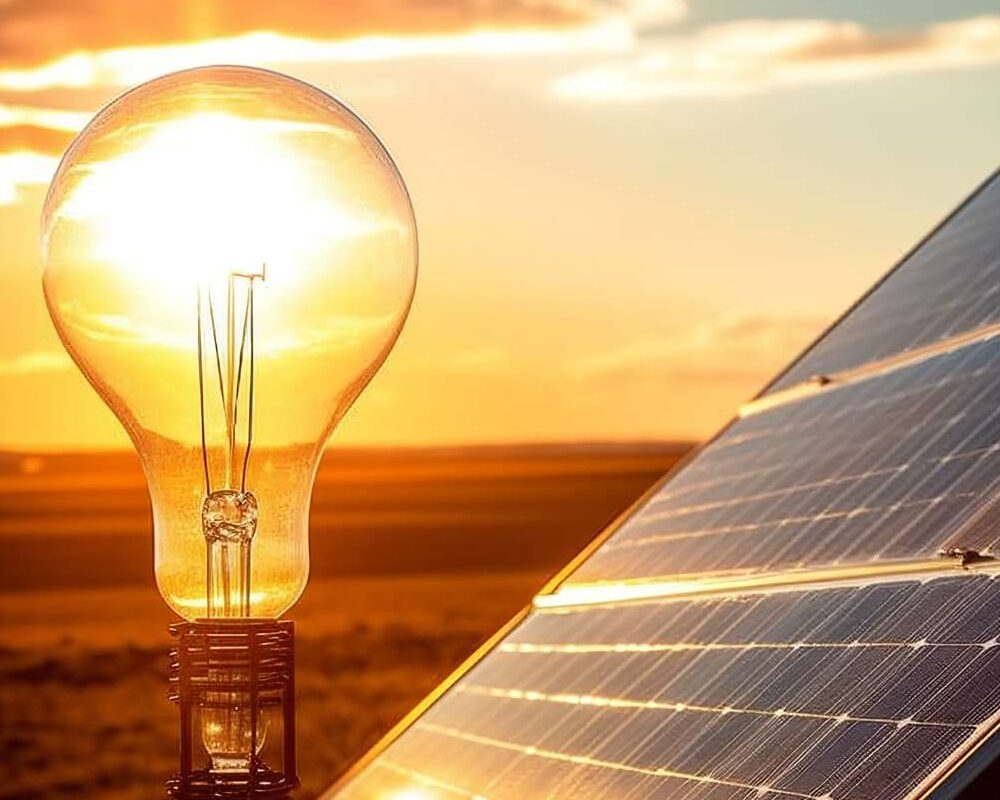
Photovoltaics, i.e. space energy.
Before we write about the types of installations, types of photovoltaic modules, power selection, etc., a few words about what photovoltaics is. With us you will learn how it is possible that: sun + photovoltaic panels = electricity in the socket.
This will be our most scientific entry, but there is no boredom.
Contents:
RES, i.e. renewable energy sources.
The simplest explanation of how photovoltaics generates electricity in sockets.
In this chapter we meet a superhero called Photon.
Revision of physics and chemistry, i.e. a little more about photovoltaic processes and photon energy.
The sun – the most reliable source of renewable energy.
Photovoltaics is included in renewable energy sources, i.e. renewable energy sources. We wrote about the advantages of renewable energy in “RES, i.e. the green energy of tomorrow”. Let us just recall that this type of energy sources:
are unlimited and publicly available (nature),
inexhaustible,
do not negatively impact the environment (they are ecological),
– do not produce exhaust gases,
– they do not generate waste,
they do not require expensive and emitting huge amounts of CO2 (carbon dioxide):
– exploitation (mining),
– transport.
The name photovoltaics itself comes from a combination of the words phos (light) and volt (voltage).
What is photovoltaics and how does it work, i.e. energy that “falls from the sky”.
The design of a PV (photovoltaic) installation is complicated, unlike the principles of its operation. So what is photovoltaics based on?
A simplified version (for laymen) of the origin of electricity from photovoltaics. Photovoltaics is based on the Sun and involves converting (converting) solar energy into electricity. This happens during the following stages.
Photons from the sun (more about the little heroes soon) fall on (most often) silicon photovoltaic cells.
Electrons are set in motion, producing direct current.
Thanks to inverters (more on inverters in a moment), direct current is transformed into alternating current (flowing in sockets).
It doesn’t get any simpler than that. 😊 That’s why photovoltaics is a “miracle” because it produces electricity:
from free fuel,
without emitting greenhouse gases and causing no side effects in the form of waste,
without your intervention,
in silence and for years.
Total cosmos, i.e. a superhero straight from the Sun.
To make the magic happen, photovoltaic panels are not enough. A cosmic (literally) photon is needed (a perfect example of the fact that not every hero wears a cape). The photon, the minimum unit of light and solar energy, is the past and the future. The past, because it is billions of years old (it was created inside the Sun in the process of collision of hydrogen and helium). The future, because it creates clean, green electricity.
What are the properties of a photon (light particle) and why is it better than the Yeti (which exists but no one has seen it)? Without a photon, there is no electricity from photovoltaics, but above all, there is no life on earth. It is the photon that transports the light and energy necessary for the functioning of the planet and the creation/feeding of all organisms. The sunlight we see and feel is nothing more than an endless stream of photons carried by the solar wind.
The photon belongs to bosons and is a quantum of light, and therefore the smallest “carrier of electromagnetic interactions” (it does not have its own electric charge). Phew… A bit complicated, so let’s simplify – the photon “does not exist”, i.e. it exists, but:
there is no smell,
has no shape,
has no taste,
there is no color,
there’s no sound.
However, he has kryptonite (like Superman), which means he is indestructible unless he hits a black hole. Plus, it moves at the speed of light. The first to hypothesize its existence was Albert Einstein.
The photovoltaic effect for the curious, i.e. a few words about the photoelectric phenomenon.
Now that you know about photons, let’s get back to photovoltaic electricity. The sun’s rays (photons) fall on modules consisting of photovoltaic cells composed of two silicon wafers. Silicon is an elementary semiconductor material and the building block of the (most common) silicon (Si) modules:
monocrystalline,
polycrystalline,
(less frequently used) amorphous.
Scheme (from the smallest element): two silicon wafers – photovoltaic cells – photovoltaic modules – photovoltaic panels – photovoltaic installation.
Okay, but what about this “magic” (i.e. where does the electricity come from)? A stream of light particles (sunlight rays) falls on the surface of photovoltaic modules. The surface (we mentioned) is composed of semiconductors, i.e. silicon wafers with additions of elements that enhance their operation. Between the plates there is an electric field represented by a potential barrier. Photons excite (by transferring energy) the passive electrons of silicon, which take over (absorb) their energy and start “working” (we have always said that you just need to “push” someone to start working). The energized electron “escapes” from the bond with the atom, leaving an electron “hole” in the semiconductor atom. P-N connector (+/conductors
-) creates an electric field, and the “holes” moving in the opposite direction to the electrons cause increased molecular dynamics. This leads to a difference in electrical voltage between the layers of the semiconductor, resulting in the production of direct current.
The generated direct current is sent via cabling to an inverter, which converts it into alternating current with a frequency and voltage consistent with the requirements of the power grid.
Simplifying diagram: photons fall on the cells – electrons absorb their energy – the movement of electrons leads to a difference in electric voltage between the layers of the semiconductor – direct current (DC) is created – the current goes to the inverter (inverter) – the inverter converts direct current into alternating current (AC) you can plug the charger into the socket and your phone is charged.
Now you have the process of photovoltaics at your fingertips. 😊 If you want to learn about the types of PV installations, types of photovoltaic modules or know how to calculate photovoltaic power, please read the next entries.